
Difference Between Accessibility, Accommodation and Universal Design


Many people use the words ‘Accessibility’, ‘Reasonable Accommodation’ and ‘Universal Design’ interchangeably. These are different terms that have specific meaning and application. In this post, we explain them in layman’s language.
Accessibility
Accessibility enables people with disabilities to reach and utilise a product or a service or information. For example, construction of a ramp to enter a building is providing accessibility; adding a ‘Word’ document as an attachment for a mailer in jpeg format is also providing accessibility.
Accommodation
Accommodation is basically catering to specific individual needs. If the person needs a WC which is higher than the height set in standards, then adding that extra attachment is an accommodation.
The law states that denying reasonable accommodation is discrimination. You cannot refuse the accommodation stating we have made it as per standards and we won’t make any further changes.
Accommodation is not just restricted to infrastructure. It could be to do with services, programmes and policies, like flexibility in timing, modification in curriculum, extra leave, extra time for writing an exam and so on.
Accommodations are always individualised. Some people may need less accommodations and some may need more accommodation.
Universal design is the concept of designing all products and the built environment to be usable to the greatest extent possible by everyone, regardless of their age, ability, or status in life.
Universal Design
Universal design is a broader term coined by architect Ronald Mace, to describe the concept of designing all products and the built environment to be usable to the greatest extent possible by everyone, regardless of their age, ability, or status in life.
It extends to policies and processes as well.
For example, an examination bed at the hospital / clinic which has adjustable height is an example of Universal Design of a product. The high examination bed that we see in clinics (mostly) requires people to climb a stool to get to the bed. It has not taken into account the wide range of patients or doctors using the bed.
Another example of universal design of a policy is having no time limit for a test (here, speed is not a consideration). Providing extra to time to people with disabilities is accommodation.
Another example is JAWS, a screen reading software. It is an additional software to be added to Windows to make it accessible. If Narrator, which is inbuilt in Windows, is upgraded by Microsoft with all features of a screen reader, it will make Windows a universally designed product / technology. The iPhone, to a great extent, meets Universal Design principles.
Accessibility is an afterthought. It could be a short term solution. Sometimes, it could even segregate people if not done carefully (like Railways have added a so called disabled friendly coach at the rear end of the train to make it accessible). Universal design on the other hand takes into account needs of maximum users including people with disabilities right from the design stage with equity as the key goal. Accommodation takes into account the fact that one size does not fit all. It is a must sometimes and as per the law denying reasonable accommodation is discrimination.
The following three pictures illustrate the three terms quite well. They shows three scenarios:
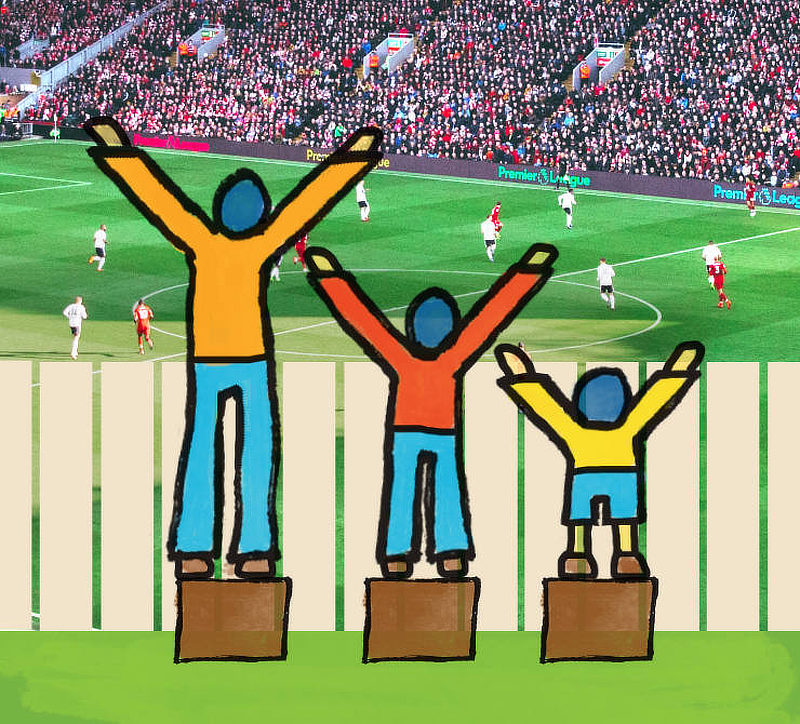
In the first illustration above, everyone is being “treated the same”. Everyone has the same size box to stand on. The short person cannot view the match at all as the environment is inaccessible. The medium-height person can watch it and also the tall person can watch the match.

In the second illustration above, there is some level of accommodation. This is individualised accommodation where the medium height person gets one box and the short height person gets two boxes to stand on. The tall person needs no boxes. All of them can view the match equally well. The accommodation leads to equity.

In the third illustration above, it is an example of Universal Design. The wall has been replaced by a transparent / see through fence. There is no accommodation (boxes) needed now, everyone can view… The systemic barrier (wall) has been removed and the design caters to all. All of them, irrespective of their heights, can view the match.